Saturday, 16 April 2016

Site Maps

A site map is a representation of a list of pages a web site will have accessible to users or viewers. They are often illustrated like a spider’s web which branches off into lots of different area’s but all link to each other in some way. Others can be more basic and feature the pages listed under the home page of the site but still show the connection between them all.

This is an example of a site map which is a lot more detailed and intricate:


As you can see, the site map features a home page of which is the main attraction and then has branches coming off of it in different directions which then have further pages and places coming off of it. Other pages also link to others if you look closer, in this example you can see that the “Independent exploration” page also links to the “WP.Browse” page.


Now I will present an example of a site map which is much simpler in terms of design:

The second site map shown features what a website would look like but in a much simpler way. Everything shown is clearly displayed and you’re able to determine what is what and how certain things are linked to each other. Along the top a menu bar can be clearly distinguished, each with smaller sub categories with their own pages and pages even inside of those pages.

Digital Communication system list

This is every digital communication system that I personally used. Everything on this list is either a website or application which allows people to distinguish this connection between each other, I will also provide the logo of each one and how I use it.
  • Facebook
Facebook is something I haven't really used until recent if i'm going to be perfectly honest but it is now an essential part of my college life. This site is responsible for me finding out where all my work is for the day or in the past. It also allows me to create a list from whats been put on there and the personal group created for our course in mind. If i need to know a deadline? Go to Facebook. If I need to look at previous work to catch up on? Go on Facebook again. The rest follows as is but without this site my time at college would be a whole lot harder in terms of completing work.
  • Skype
Skype is one of the items on this list that I use the most. Ever since its creation and replacement of MSN, i've been using this program to keep in touch with not only real life friends or relatives but also people I don't personally know in real life and have met through social activities online. The call feature on Skype also allows me to chat and talk with all of the said people above with ease and in a way that isn't heavy on my bandwidth.


  • Gmail
Gmail is my preferred choice of host to have an email on. But what are my reasons for this? Well for one, its owned by Google. If I was going to trust any particular email provider it'd be the one owned by the biggest and most popular company online. Not only that but Gmail blows hotmail and Yahoomail out of the water, I can compose emails wherever I go as well as enable two factor security on my account which isn't even possible on Yahoomail yet.


  • Reddit
Reddit is a controversial website but I can't stop using it. Reddit which literally means "Redd It" as in you've read it, is a website that allows you to enter and go on different categories and subcategories for anything, this accounts for the weird and down right vile too though. Personally I use this to discover and learn about current world affairs as well as internet culture. It also lets me enter specific and certain fandoms of games, television shows or even if i'm in the mood to just look up some funny pictures.
  • STEAM
Steam is the application I use the most, this may seem as foreign to the average internet user but basically what steam is, is an application which allows me to play a range of different games on my computer as well as purchase games and play around with friends i've accepted. On top of this, Steam also let's me view screenshots, fan art, discussions and my friends activity feed all under one application. The best analogy for this would be that it's like Facebook but if Facebook were for games and gamers.

This is definitely the application and social media site/application I use the most as since first creating an account in February 2012, I have clocked over 4200 hours on one game alone.
  • Discord
Discord is new to me, I haven't used it much if i'm going to be perfectly honest but it still makes this list. This application is a VOIP website, and if you're wondering, VOIP stands for Voice Over IP. My main use for this site so far is to communicate and talk with my friends who also play games alongside me. Though i've listed two over VOIP programs, Discord comes into use when I talk and play with a particular group of friends that I have on a certain game. The symbol and outplay of a controller can also be made if you look at the logo as well, as seen here.


  • Mumble
Mumble is another VOIP program and the one I used the most out of all the programs like this that I will list. I play competitive e-sports in my spare time so this program comes in extremely helpful. With my team and I, i'm able to have an overlay which means I can see who's talking and when as well as communicate effectively in a move towards trying to win the game.

There's not much more to say on top of this except that I definitely recommend this above all other VOIP programs. Mumble really sets the standard for communicating and talking over mic for gaming purposes.

  • TeamSpeak
You're probably tired of hearing me speak about VOIP programs now but I promise this is the last one. Teamspeak can be considered the carbon copy of Mumble but there's a lot more that people overlook with this program I think. Unlike Mumble, Teamspeak is a lot more simple as well as laid out in such a way that makes it very user friendly. The thing that Mumble has which puts it on top of Teamspeak is that there's no overlay for when you play games. Nevertheless, a really great program and one that I use on a weekly basis to converse with my closest friends all in one open area.


  • YouTube
Internet giant and superstar steps into the ring! No, but seriously, its YouTube, if you don't know what this is or haven't heard of it... Well, where have you been all this time

Youtube is a video sharing site where users can create and account and upload their own content in seconds. Since its release and the accessibility of the internet dramatically increasing, YouTube has blown up in popularity and has quickly become everyones source for music, gaming, news, how-to guides and people thoughts + opinions of popular current topics. Personally, I use YouTube every single day since I've first created an account in the start of 2008. I've been the one that uploads content as well as the one who's also watched others and the use of subscribing to someone lets you get notified about every single video that person uploads.
  • Bandcamp
Another fairly new website to me, Bandcamp is a site where people can publish their music online and others are able to purchase it. Sure it's outclassed by the likes of Itunes or Google Music but the website is not entirely useless. The website offers a feature that I think makes it stand out from the rest, people who publish their music can opt and choose a feature that allows you to pay what you want for certain albums or singles. This depends on if the uploader and publisher allows it though. The reason why I think this is so great and good is because I'm able to support unknown and underground artists that I feel perhaps deserve a little something for the music they make.

  • Soundcloud
Soundcloud is another music website that you can publish music on. I use this to follow upcoming artists as well as some popular ones, they upload snippets or full tracks to the site in which people can comment on as the track plays. If you hear a part of the song that you really like you can comment saying you like it and others or the uploader can see it. Another use for this site is for artists across the world to collaborate and put all their music in specific group or place.
  • Twitch.tv
Twitch.tv is holy grail of gaming content, think about all the games you can play on Steam, Playstation, Xbox, Nintendo platforms as well as mobile games and then apply then think about watching those games live alongside others.

This is a unique and new idea that has grown in popularity in recent years. The concept of watching someone else playing a game is odd, why watch a game when you can play it yourself? Well, maybe you'd understand better if you listened to my reasoning behind why I use the website.

I use Twitch to watch competitive matches be played about my favourite games as well as watch familiar faces and content creators on YouTube. Gaming channels often down upload every single day but take to Twitch as an alternative they take and here is where I can watch extra content of that person with live reactions and gameplay as it happens. I'm able to talk an communicate with the streamer via text and it gives you a deeper level of interaction other than just writing a YouTube comment.
  • Blogger
And my last and final piece of social media/application that I use, Blogger. Blogger goes all the way back to Facebook and link because of the reason I use them for. What this is all written on, is blogger, how all my college work will be assessed is via Blogger. Without Blogger, i'd be using a sketchbook and various different pencils/pens to create my work, which personally I think is boring and pretty generic. Blogger allows me to present this information for my work in a way that is 100% always readable, a way that relies on no printing at all and a way that I can display and show off information digitally.

3 Digital communications sites or applications

1. Twitch.tv

Justin.tv was launched in 2007 by Justin Kan and Emmett Shear, though this is not directly Twitch.tv, it is what created the popular site. On Justin.tv, everything was split up into categories dependant on content, this meant that initially people could stream more than just games. However, the gaming category on the site grew exceedingly fast and then soon became the most popular content on the site. This lead to the company deciding to create a spin off of the gaming content now known as Twitch.tv in 2011 on June 6th.

Twitch.tv is a video streaming service where people can create an account and begin to Livestream playing games. This means that viewers can click on their stream and watch them play the game live, so everything happens in real-time. The idea of this is certainly odd to anyone not interested in gaming culture or doesn’t play games regularly online but to some, it allows people to look at a game and watch someone play it to determine whether or not they want to purchase it and be able to interact with other viewers of the same stream. Another big reason people do this is because it allows content creators over on YouTube and their fans to also interact together in an environment whilst they also watch the content they would normally see on their YouTube channel. Charity streams and events have also been done online where viewers are encouraged to donate their money with pre-determined challenges the streamer must do.

2. STEAM

Steam is an internet-based digital distribution platform developed by Valve Corporation and written in C++. The initial release of Steam was on the 12th of September 2003 (12 years ago) and allows users to play games from a built in store. Its purpose for being created was to allow users across the world to play games together and make new friends who share a common interest or play the same game, and in later years allows users to create their own content for certain games which can be added into the actual game later in time. The site also allows you to add other users and interact with them, you can trade items found in certain games like TeamFortress 2 and Counter Strike: Global Offensive as well as chat via VOIP (Voice over internet protocol) or open chat windows with accepted friends to talk via text.

The community is huge on steam, within each game approved (there are over 6,400 games on steam) and sold on the software is a community hub where people can upload videos, screenshots, artwork or discussion topics in which others can comment, share or upload their own content. The community also has a workshop for multiple games that are moddable and allow user created content to be added into the game, enhancing players play time and experience. Here is where people and fans of the games made and on the software can create their own in-game assets and maps which another player can either add to their subscriptions and be able to play in game or in some cases, like TeamFortress 2, create a new cosmetic your character can wear. These cosmetics, if accepted into the game by Valve allows the creator to receive a portion of the money earned every time someone purchases the item so it also supports independent content creators and freelance artists, modellers and script writers in the form of Greenlight. Greenlight is the same of the community workshops but allows companies or indie developers to publish their own game up for review and if accepted, they can start to make a living from the sales they receive when someone purchases their game.

3. Skype

Skype is an application that provides users with the ability to create video chat or voice calls with other users and even registered phone numbers. As well as this, users can also exchange text, images. files and video messages amongst each other. The program was first released in August 2003 by Niklas Zennström and Dane Janus Friis from Sweden in cooperation with Ahti Heinla, Priit Kasesalu, and Jaan Tallinn from Estonia which developed the backend of the program.

For years has this program been a part of my life, I've met many new people and spoke to a range of different people from all over the world. Some have left and moved on and some have continued to stay in contact even to this day. I don't think that without Skype, I would have half the friends I have still nor still be in contact with friends ever since my childhood. Skype impacts my life on daily basis and has always been there and running if I need to contact or talk to someone, I can connect to the internet, open Skype and start talking to my friends instantly via text or VOIP (Voice Over IP).

Friday, 15 April 2016

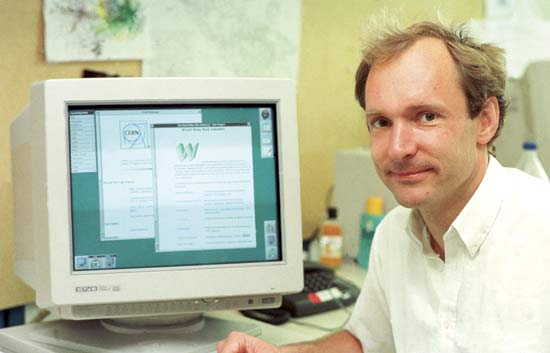
Who is Tim Berners-Lee?

 Tim Berners-Lees is an English computer scientist who is best known as the creator and inventor of the World Wide Web. I've already discussed the different between the internet and the World Wide Web and a common misconception is that he created the internet, when in actual fact he didn't.

So how did he do it?

The proposal for an information management system was first brought forward by Tim Berners-Lee in March 1989 but didn't actually come to completion until later in the year, in November. What Tim did was establish a successful communication between a HTTP (Hypertext Transfer Protocol) and server via the Internet. This breakthrough spawned and created the World Wide Web that we know today.

What happened after the creation of the World Wide Web?

Because of Tim's work, he was knighted in 2004 by Queen Elizabeth II and since received other awards/honours including being elected as a foreign associate of the United States National Academy of Sciences.

Now in recent years, Tim launched what's called the Alliance for Affordable Internet, this is a coalition of public and private organisations that seeks to make internet access more affordable for people all across the world. This in turn will decrease internet access prices as well as broaden the developing world so more people can have access to the large of information the internet harnesses.

Thursday, 14 April 2016

Online Journalism Content and Writing

Chosen websites to look at:

http://www.dailymail.co.uk/

And

http://factor-tech.com/

The Daily Mail is a British national daily newspaper which originally started off as a tabloid newspaper in 1896 and is now the second biggest selling newspaper in the UK after The Sun. Since its initial release it has remained popularity and has over 100 million unique visitors on their website every month. The Daily Mail also features news stories local and worldwide covering a range of topics such as sports, celebrity news and Travel.

My second chosen website is Factor-Tech, Factor-Tech is a science and tech online magazine which publishes information and news on recent events all things tech and science. On the website large categories such as space, future cities, robots and wearables are present on the main menu visible at the top of the pages.

Two example stories:

The full story copied here –

ROBOTS
ROBOTIC KITCHEN TO GIVE
EVERY HOME ACCESS TO A
PERSONAL CHEF

November 19, 2015 | Daniel Davies

Hidden away in a small office in central London is the future of food preparation: a large pair of robot arms will now take care of cooking in the home, so you don’t have to.

Once development is completed, the robo-chef, designed by Moley Robotics, will give its owners access to a downloadable menu of thousands of dishes.

The robot works by rigidly copying the actions of a human who has previously made the same meal while being filmed by 3D motion capture technology and wearing cyber gloves. This information is then placed on the Moley app, where users will be able to select recipes based on ingredients, cuisine or dietary needs.

For the demonstration, this former Masterchef winner Tim Anderson was filmed, but there’s nothing to stop Gordon Ramsey, Jamie Oliver or Tom Kerridge being imitated by the robot in future, which would give every kitchen access to a celebrity chef.

<Video image>

The prototype caused quite a furore when it was unveiled at the Consumer Electronics fair in Shanghai, so much so that potential customers had to be turned away, disappointed, while its designers prepare it for commercial release at the end of 2017.

The founder of Moley Robotics Mark Oleynik does eventually see the product being available to a mass market and would be happy to see the product in kitchens across the globe.

“We’re not making kitchens out of diamonds and covered in gold,” says Oleynik. “We are focused on making a mass-market product.”

For this to be the case the cost of the robot kitchen would have to fall dramatically. Currently the robot is expected to cost $75,000 at launch.

However, Oleynik does believe the cost will drop dramatically in a relatively short period of time.”A regular mid-level kitchen costs £20,000, for the whole kitchen, this level of cost is achievable in four to five years time,” he says.

But Oleynik isn’t convinced the price will drop much beyond that point. He says: “We’re not competing with Ikea,” and cites the differences in mobile phone technology as a way of illustrating his point. “You can use a simple telephone for £50 but it has no functionality. We’re trying to strike a balance between price and functionality.”

Oleynik explains that the robot is “not replacing people, it replaces boring operations”. The robo-kitchen’s creator sees it as a tool to combat the urge to eat ready meals, takeaways and a fast-food diet, all of which can have a detrimental effect on people’s health.

He doesn’t believe it will take over from the human chef. In fact, he argues that the device boosts competition as anyone will be able to upload their cooking to the platform.


If the robo-chef were to be seen in professional kitchens then the humanoid hands, which are such a feature of the machine’s design, may be excluded or at least sped up. Head of engineering David Walsh explains: “Right now it’s entertaining in a commercial kitchen, but they wouldn’t need that entertainment factor [in a professional kitchen].”

For the moment, though, the team aren’t concerned with developing for restaurants; they’re working on adding as much functionality as possible for the domestic market, so eventually the machine will be able to clean itself and chose between items which haven’t been laid out in a set pattern.

Once this functionality is included, and the price drops, we may see the robo-kitchen in homes round the world, but as Walsh says: “At the minute it cooks for me, but it’s easier to just get a sandwich.”

--Article ends here--

How did you find this story?

I found this story by looking on the “Robots” section of http://factor-tech.com/ after scrolling down through the stories for something interesting. The article has its own link which is http://factor-tech.com/robotics/20694-robotic-kitchen-to-give-every-home-access-to-a-personal-chef/.

What grabbed your interest?

What first initially caught my eye was the headline of the article, “Robotic kitchen to give every home access to a personal chef”. Technological advances are always being made and this is one that’s been at the top of people thought when they imagine advanced robots able to complete actions and do tasks. For example, take a second to think about the headline written, your own personal chef?! Sounds pretty amazing to me.

After reading into the article further the second paragraph states “Once development is completed, the robo-chef, designed by Moley Robotics, will give its owners access to a downloadable menu of thousands of dishes.” This makes the headline so much better and backs it up well, as well as gives a good insight into what to expect. Not only would this be your own personal chef but it’d also be able to have access to a downloadable menu of which contains thousands of dishes. This along caught my attention and drew me in to find out more.

How many pictures were used with the story?
One picture was used in the article; this image helps provide a visual reference to what’s been written in the article as well as acts as an aid for viewers who are unable to play the video also placed on the article a little above it. The image features one of the robotic arms pouring the contents of a glass beaker into a pot as the pot is being heating. This image also displays the fact that the robot actually works and is capable of completely functions needed to create a meal when all ingredients are laid out. Though just one still image is not enough proof of this, the video featured shows this off and proves that the robot is capable of not only adding ingredients to the pot but also stirring the butter and ingredients added.

The image used –


Is the copy written in a way to get the attention of the reader?

This article is written in such a way that it grabs the attention of the reader right now the start. As shown earlier, in the second paragraph, the headline of the article is expanded on and given more of an insight to what is meant by a personal chef, its also shows off what its capable of making the reader more interested and seem as if its development is a lot closer to completion than it may be. People who are interested in tech news and robots will find this interesting because generally this sort of audience want aid in every day tasks and monotonous and boring tasks such as preparing a meal.

The article then goes on to explain how “The robot works by rigidly copying the actions of a human who has previously made the same meal while being filmed by 3D motion capture technology and wearing cyber gloves.” Motion capture technology is another big topic in the tech world but is nothing new in recent years but it does give an idea to deeper thinker of if these hands can perform actions done using cyber gloves, inputting different actions such as brushing your teeth for instance could be possible and in the future we may even have robots brushing our teeth for us.

Our fourth paragraph opens with the following few words, “For the demonstration, this former Masterchef winner Tim Anderson…” The reason why this stands out and is attention grabbing is because its something we can relate to; Master Chef. Master Chef is a popular televisions show in which competitors show off their culinary skills to impress a set of judges. Since its launch, the show now has many international versions spanning from Asia to Brazil and the western side of the world. Its relatable because the show is shown on prime time television and is also watched worldwide by families. This beginning line also gives credibility, the show and its winners are very respectable people in the world of cooking.

Now the article turns to a video, where the robot demonstrates what its capable of. The video keeps the viewer interested because it adds a moving image element to it and provides further evidence to what the article is about. All skepticisms are debunked and the proof of the robot’s capabilities are shown.

The article then goes on to explore the viewers of people who have seen the robot in action as well as the thoughts of the creators as well as what they want the direction of the robot to be. This robot “was unveiled at the Consumer Electronics fair in Shanghai…” and caused so much of an uproar. “…so much so that potential customers had to be turned away, disappointed, while its designers prepare it for commercial release at the end of 2017.”

A change in the article is now made and it takes a different tone, the exciting and hype building content is over and the rest of the article features statistics and statements from the creators. This doesn’t appeal to everyone but to the interested reader hoping to purchase one of these from what’s been written above in the article they are once again enticed as figures such as “$75,00” and “£20,000” stand out and draw the readers attention to them.

Thoughts of the creator are expressed and written in the beginning of the next 3 paragraphs, explaining key information such as the cost of the product becoming increasingly cheaper as time goes on, how they’re trying to strike a balance between price and functionality and also how the robot wont replace people but replace boring operations found when working in the profession as a chef.

The article ends strong recapping and going over what has been said earlier, as well as providing some additional information about its future. It ends the subject on an exciting note and one that allows the viewer to think about the robot in perspective. Creator Mark Oleynik says “…eventually the machine will be able to clean itself and chose between items which haven’t been laid out in a set pattern.” Giving an inside view to its future and the article finishes on a short summary of the entire article and the exciting future for this product.